Mecart, Studios and Acoustics Solutions
Français
           
Home   Company Studios    
Acoustic
solutions
    Contact
                         
Mecart, Studios and Acoustics Solutions
     
    Acoustic Solutions

 
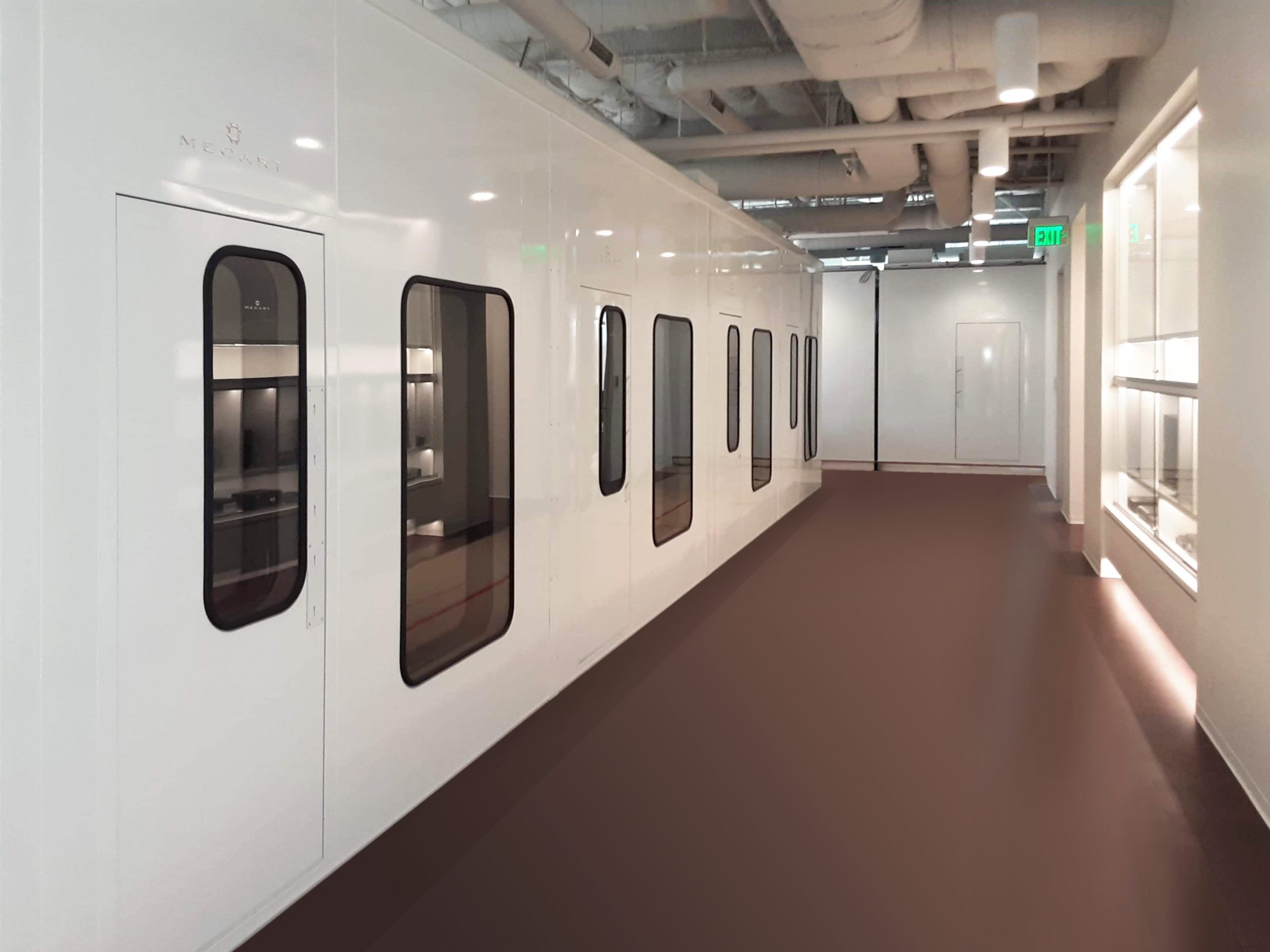
  MECART modular studios are soundproof and vibration-proof shells, but most of all they offer balanced resonance. The “sound” is the very soul of a studio. Below are a few predetermined factors that affect the acoustic behaviour of a studio:


Studio Dimensions

Acoustical Treatment

Studio Soundproofing

The MECART advantage


    Studio Dimensions


Reflection, absorption and sound transmission
Resonance

The behaviour of low frequencies is largely influenced by the dimensions of the studio. Low frequencies are amplified when they are reflected off studio walls, generating resonance peaks. There are three types of modal frequencies: they are known as axial, tangential and oblique modes. Axial modes consist of waves resonating off only two opposing surfaces. Tangential modes involve four different surfaces. And oblique modes involve reflections ricocheting off all six surfaces. These three types of modes determine the resonance that is generated. Using a specific set of proportions will produce a better distribution of modal frequencies.

Top

 
  Coloration

Coloration of sound occurs when there is an isolated, dominant frequency that is heard separately. Resonance amplifies low frequencies and always produces a certain coloration. A low level of coloration is critical to the acoustical quality of a studio.


Top

Proportions


Studios Dimensions

There are ideal room proportions for the dimensions of a studio with six surfaces. These ideal proportions provide an optimal distribution of modal frequencies. Although they will not guarantee good room acoustics, they are a good start. If a studio does not have ideal proportions, acoustical treatments will be that much more important for obtaining a balanced sound.


Top

    MECART solutions

MECART acousticians will calculate and validate the optimal proportions for your studio in terms of available space.

Top


Acoustical Treatment

 
  Absorption


Absorption coefficients of different materials
Sound energy is absorbed when it is converted to another form of energy. In most cases, this takes the form of conversion to heat. This results from the actions of friction and the resistance of various materials to movement and deformation. Obviously the amount of heat generated is minimal as the sound energy is also quite small. It is important to note the distinction between this absorption (the amount of sound energy actually converted to heat) and the absorption coefficient, since the absorption coefficient refers to all the sound energy that is not reflected (i.e., it includes the transmitted as well as the absorbed component). Absorptive materials naturally perform better with medium and high frequencies. Panels can be made of selected composite materials for the absorption of low, medium and high frequencies.
 
Top


Reverberation time 60 (RT60)


Acceptable reverberation
versus room size at 500 Hz


Percentage of optimal RT60
at 500 Hz versus frequency


Reflection and transmission

If a sound is not absorbed or transmitted when it strikes a surface, it will be reflected. The law of reflection is the same as that for light, i.e., the angle of incidence of a sound wave equals the angle of reflection, just as if it were produced by a 'mirror image' of the stimulus on the opposite side of the surface. However, this law of reflection holds only when the wavelength of the sound is small compared to the dimensions of the reflecting surface. Sound reflection gives rise to diffusion, reverberation and echo.

Diffusion is the process by which a sound wave is distributed in a space. If the sound pressure is uniformly distributed throughout the space, the sound is said to be well diffused. Diffusion of sound is important for studios in order to avoid dead spots. Good diffusion can be achieved in several ways:


Alternating sound-reflecting and sound-absorbing surfaces.


Randomly distributing surfaces with different absorption coefficients.


Incorporating numerous surface irregularities and reflecting elements into the space.

Generally, concave surfaces focus sound waves, whereas convex surfaces scatter sound waves and help produce good sound diffusion.

MECART employs primarily the first method, which entails alternating sound-reflecting and sound-absorbing surfaces through the use of acoustic absorption panels on walls and ceilings. MECART has refined this method to produce some spectacular results.

Top

Reverberation

A studio’s reverberation time is the time it takes the sound to decay 60 dB after the sound source stops.

Top  

MECART Solutions

Evaluate reverberation time in octave or 1/3 octave frequency bands depending on application, i.e., music, speech, radio and so forth.

Calculate the number of MECART acoustic absorption panels required, while considering the possibility of a suspended ceiling or absorptive floor covering.

Plan arrangement of acoustic absorption panels and the addition of diffusion panels, where necessary.

Top  


  Studio Soundproofing


Background Noise


1971 Preferred noise criteria (PNC) curves (1971)


Recommended category classification and
suggested noise criteria range for steady
background noise as heard in various
indoor functional activity areas
In environments such as private homes, office buildings, schools and restaurants, equipment such as H.V.A.C. systems, fans, refrigerators, sound systems, light fixtures and so forth, are likely to generate background noise.

Background noise is the term used to describe the level of noise measured in the absence of specific noise sources. The background noise level is symbolized by L90 or L95 (the noise level present 90% or 95% of the time). MECART studios are designed to minimize sources of ambient noise to the level required by the application.

Connecting studio ventilation to the building ventilation system, for example, could generate noise inside the studio, and increase the background noise level. MECART manufactures various models of ventilation silencers to deal with this issue, and installs the appropriate ones to achieve the desired background noise level.

Top


Typical curves STC


Transmission Loss

Single Wall


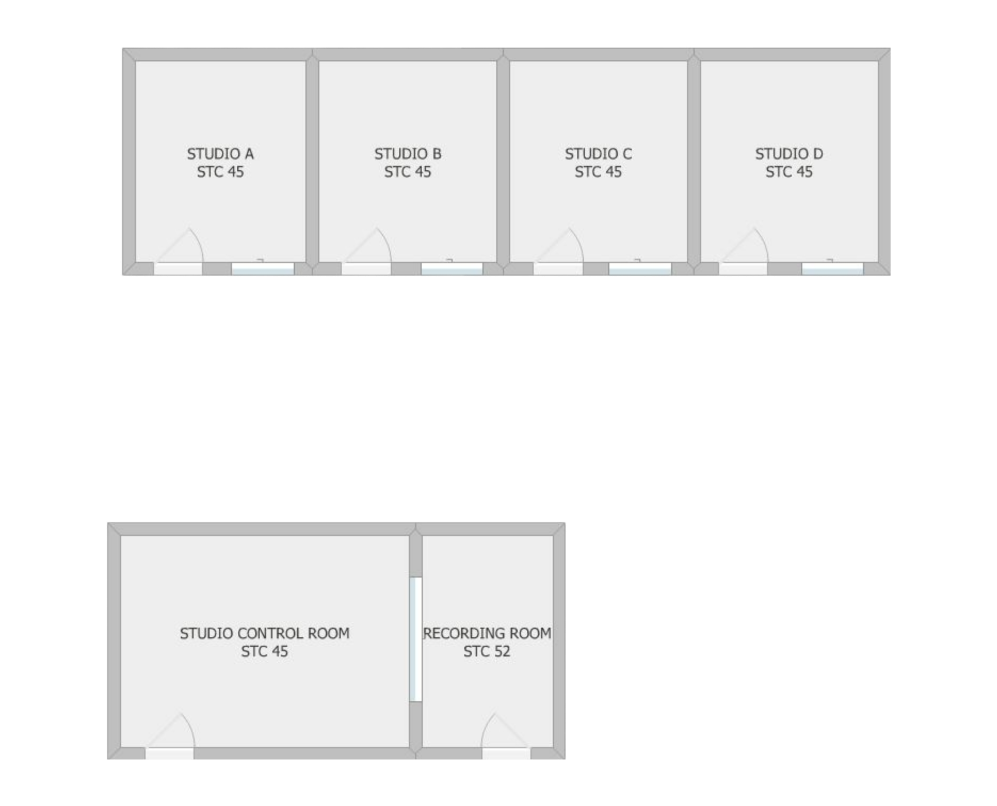
Testing at an independent laboratory demonstrated that a MECART wall consisting of panels, a door and windows performed to the STC-45 rating.

Double Wall

In situ testing demonstrated that a MECART double-walled studio with two optimally spaced walls, panels, a door and windows performed to the STC-70 rating.


MECART soundproof doors


Door

MECART offers different modular door models that can also be installed in conventional walls. The single-wall door is rated STC-45 and the double-wall door STC-70. A magnetic seal is installed around the door perimeter to ensure soundproofing. And it should be noted that door windows have no impact on acoustical performance because of their multiple panes.

MECART windows


Windows

MECART windows are rated from STC-45 to STC-70, and are offered in standard and custom sizes.

Top
  Vibration Isolation

 
Outdoor vibrations
Indoor vibrations
MECART has solutions for preventing both the transmission of building vibrations into the studio, and the transmission of vibrations from inside the studio to the building. Such vibrations will generate noise both in and outside the studio, and if left untreated could exceed the background noise level. The most common vibrations come from hallways (footsteps and elevators), H.V.A.C. (fans) and terminal boxes.
 
Top


  MECART Solutions


MECART Floating Floor

For studios where vibration reduction is not an issue, the MECART floating floor is an effective and economical solution.


MECART Modular Floor on Isolation Pads

For studios where vibration reduction is essential or where the background noise level is critical, MECART’s modular floor is an effective solution with a good quality-price ratio.


MECART Modular Floor with Anti-vibration Foundation

For studios subject to noise-generating vibrations, the anti-vibration base is indispensable for professional, ongoing use studio.

Top


  Advantages of MECART Acoustic Solutions

 
  High Performance Studios

 
Concentration and Performance


Soundproofing and reduction of noise-producing vibrations to desired levels.


Acoustics calibrated for specific use (radio, music, etc.).

Enhanced User Performance


Efficient working environment.


Flexible layout to enhance functional use.

Top
 

  Copyright© 2005-Mecart Inc.

Home

Company

Studios
Acoustic
solutions

Contact